The most Google search alternatives Privacy
For years, Google has dominated the web search market, becoming almost synonymous with “searching online.” While its convenience, speed, and powerful algorithms are undeniable, growing concerns around privacy and data collection have led many users to explore Google search alternatives.
Google tracks user activity extensively—collecting search history, location data, and even browsing patterns. This information is often used for targeted advertising and personalization, which can feel invasive to privacy-conscious individuals. If you’re not happy with this level of monitoring or simply want a new browsing experience, it’s time to consider privacy-friendly options.
Luckily, there are excellent Google search alternatives that emphasize anonymity, unbiased results, and user control. In this article, we’ll explore the most trusted names like DuckDuckGo, Startpage, Bing, Tor, and newer players like Qwant and Swisscows. By the end, you’ll know exactly which option fits your needs.



DuckDuckGo – A Privacy Powerhouse among Google search alternatives
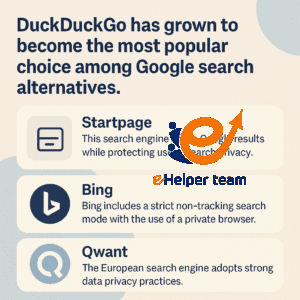
DuckDuckGo has grown to become the most popular choice among Google search alternatives. Founded on the principle of “privacy first,” DuckDuckGo promises never to track or store your searches.
How DuckDuckGo Protects Your Data
Unlike Google, DuckDuckGo doesn’t save IP addresses, log user activity, or build user profiles. This means your searches remain private, and no advertiser can follow you across the internet. Even your browsing sessions are secured with HTTPS encryption.
Search Features and Result Sources
DuckDuckGo pulls information from more than 400 trusted sources, including crowd-powered platforms like Wikipedia, news outlets, and other search providers. Its “bangs” feature lets you quickly search specific sites (e.g., typing !w AI takes you directly to Wikipedia).
Watch a quick DuckDuckGo overview here
Startpage / Ixquick – Privacy-First Metasearch Engines
Startpage, also known as Ixquick, is another respected option among Google search alternatives. What makes Startpage unique is that it delivers Google search results—without allowing Google to know who you are.
Data Handling and Anonymity
Startpage doesn’t record your IP address, search history, or identity. It serves as a private middleman, fetching Google’s search results on your behalf, which ensures you get high-quality results with full privacy protection.
Built-in Tools: Proxy, SSL, URL Generator
Startpage also includes a proxy browsing option that lets you visit websites anonymously, strong SSL encryption, and a URL generator that stores your preferences without cookies. These features make it a top pick for those who value both convenience and security.
Learn more about Startpage in this video
Bing – A More Private Alternative or Not?
Microsoft Bing ranks as the second largest search engine in the U.S. While it’s not strictly privacy-focused, many users consider it a solid option among Google search alternatives.
Ownership, US Reach, and Privacy Considerations
Bing, like Google, does collect data but on a smaller scale. It offers features such as transparency in ad preferences and stronger controls for personalized ads. For those who prioritize functionality over absolute privacy, Bing remains a valid option.
Unique Perks: Rewards, Creative Commons Search
Bing offers a rewards program, where users earn points redeemable for gift cards or donations. Another standout feature is its Creative Commons search, helping creators easily find usable media for blogs, YouTube, and business purposes.
Tor Browser – The Ultimate Anonymity Toolkit
Unlike other engines, Tor isn’t just a search provider—it’s a browser designed for maximum anonymity. Known as “The Onion Router,” it routes your internet activity through multiple encrypted layers, making tracking almost impossible.
Onion Routing and Encryption Layers
Tor’s multi-node system ensures your IP address and identity are hidden. Each connection layer peels away like an onion, providing extra protection at every stage.
Ideal Use-Cases and Limitations
Tor is best suited for journalists, activists, or anyone requiring the highest degree of online anonymity. However, browsing can be slower compared to traditional search engines, and some websites restrict access to Tor users.
Other Emerging Private Search Engines
Beyond the big four, a wave of new Google search alternatives has surfaced, focusing on niche audiences and advanced privacy measures.
Meta Search Options (e.g., Dogpile)
Dogpile combines results from engines like Google, Bing, and Yahoo into one list. While not as privacy-centered as DuckDuckGo, it’s useful for broader search results.
Privacy-Centric Newcomers (e.g., Qwant, Swisscows)
Qwant: A France-based engine that avoids tracking, offers news and social media filters, and promotes neutrality in results.
Swisscows: Operated in Switzerland under strict privacy laws, it emphasizes semantic search and family-safe content.
Comparative Insights: Which One Should You Choose?
When evaluating Google search alternatives, the choice depends on your needs:
Maximum Privacy: Choose DuckDuckGo, Startpage, or Tor.
Feature-Rich with Rewards: Bing offers extras but with trade-offs in data collection.
Regional or Family-Oriented Needs: Qwant and Swisscows may be better.
For most users, a combination of these services works best—using DuckDuckGo daily, Startpage for Google-quality results, and Tor for highly sensitive browsing.
While DuckDuckGo, Startpage, Bing, and Tor are the most well-known names, the search privacy landscape has grown rapidly. Several newer engines bring unique features that deserve attention.
Brave Search – Independent and Customizable
Unlike most alternatives that rely on Google or Bing, Brave Search operates on its own independent index. It offers:
Discussions Tab – shows community-driven answers (e.g., Reddit threads).
Goggles – custom filters that allow you to prioritize or block certain sites.
API access – letting developers integrate Brave Search into apps.
Brave is tightly connected to the Brave browser, but it can also be used as a standalone search engine.
Kagi – Premium Search for Maximum Privacy
Kagi takes a unique approach: it’s subscription-based and ad-free. That means:
No tracking or targeted advertising.
Tools like Lenses, which let you filter results (academic papers, blogs, PDFs, etc.).
Transparency reports showing how many ads or trackers were blocked on each page.
For users who value both premium search quality and privacy, Kagi is becoming a favorite.
Presearch – Decentralized and Blockchain-Powered
Presearch uses blockchain technology to decentralize search. Instead of a single corporation controlling data, it runs across independent nodes.
Users can earn PRE tokens when they search or run nodes.
No search logs, IP tracking, or fingerprinting.
A community-driven system where advertisers pay with tokens, keeping the economy self-sustained.
This makes Presearch attractive for crypto and decentralization enthusiasts.
SearXNG – Open-Source and Self-Hostable
SearXNG is an open-source meta-search engine that you can even host yourself.
It queries results from 70+ sources without storing user data.
Perfect for organizations or individuals wanting complete control.
Since it’s community-driven, there’s no central authority tracking activity.
It’s more technical, but incredibly powerful for advanced users.
Mojeek – Crawling the Web Independently
Based in the UK, Mojeek is one of the very few fully independent search engines.
It maintains its own web index (billions of pages).
Offers unbiased, non-personalized results.
Strongly focused on privacy—no cookies, tracking, or profiling.
Mojeek is growing steadily and is often praised for transparency and independence.
Swisscows – Family-Friendly and Semantic Search
Swisscows, based in Switzerland, takes a unique approach:
Doesn’t store user data at all.
Uses semantic search, meaning it understands context, not just keywords.
Built-in family filter—ideal for safe browsing environments.
Provides extra services like VPN and encrypted email.
It’s especially strong in Europe, thanks to Switzerland’s strict privacy laws.
Future Trend: SwarmSearch – AI Meets Decentralization
A recent research project called SwarmSearch experiments with a peer-to-peer, fully decentralized search engine powered by AI.
Designed to resist manipulation from bad actors.
Ensures accuracy without needing a centralized authority.
Still in development, but could represent the next generation of private searching.
Why These Matter
These newer engines expand beyond traditional Google search alternatives by offering:
Independent indexes (Brave, Mojeek).
Paid but ad-free models (Kagi).
Decentralization and token incentives (Presearch, SwarmSearch).
Open-source transparency (SearXNG).
Semantic intelligence and family safety (Swisscows).
This evolution shows that private search is no longer niche—it’s becoming a full ecosystem with options for every type of user.
FAQs
1. Why should I consider Google search alternatives?
Because they provide more privacy, reduce data tracking, and offer fresh search experiences.
2. Is DuckDuckGo really private?
Yes, it doesn’t track or store your searches, making it one of the safest mainstream options.
3. Does Bing respect my privacy more than Google?
Not fully—it still collects data, but Microsoft provides clearer controls and transparency.
4. Can I use Tor for everyday browsing?
Yes, but it may feel slower, so most users reserve it for privacy-sensitive tasks.
5. Are Qwant and Swisscows reliable?
Absolutely, they are growing in popularity across Europe and are strong contenders for those wanting privacy without sacrificing usability.
6. Do private search engines affect search quality?
Not significantly. DuckDuckGo and Startpage offer excellent results, often pulling from Google or Bing indirectly.
Conclusion
The internet doesn’t have to be a trade-off between usability and privacy. With Google search alternatives like DuckDuckGo, Startpage, Bing, Tor, Qwant, and Swisscows, you can control your data while still accessing high-quality search results.
As online privacy becomes more critical, expect these engines to keep evolving, offering even better security and smarter results—without the tracking.
Read also: Master Google Drive Search Operators: Instantly Find Any File with These Expert Tips